CASE STUDY / 05 / PRODUCT ENGINEERING
From syllabus to study session.
I built Haven Education around a problem I face myself: knowing what needs to be studied is not the same as sitting down and doing it.
RECRUITER BRIEF / WHAT THE EVIDENCE SUPPORTS
My engineering work
Developing a React study workflow connecting course setup, tasks, focus sessions and progress, with a review step for uncertain syllabus extraction.
Inspect first
Real interface captures from an isolated demo workspace and implementation decisions. Source is private; recruiters can ask for a demo.
Verification boundary
Active development with private source. Project status and demo-data context are summarized below.
Less tracking work. More actual studying.
As an electrical engineering student, I spend time juggling course outlines, deadlines, lecture topics and study sessions. That information often lives in different places. I wanted a single workspace where I could see the semester, choose the next task and understand how I was using my time.
I use Haven to structure my own studying, so the design questions are practical: Can I figure out where I stand in a course? Is the next useful action obvious? Can I start focusing without reorganizing my entire day?
One workflow, connected end to end.
Haven links course context to planned work, then to recorded study time. Uncertain extracted dates stay in a student review step.
- 01 / INPUTCourse outline
Import course material and review parsed weeks, assessments and uncertain dates.
- 02 / CONTEXTCourse progress
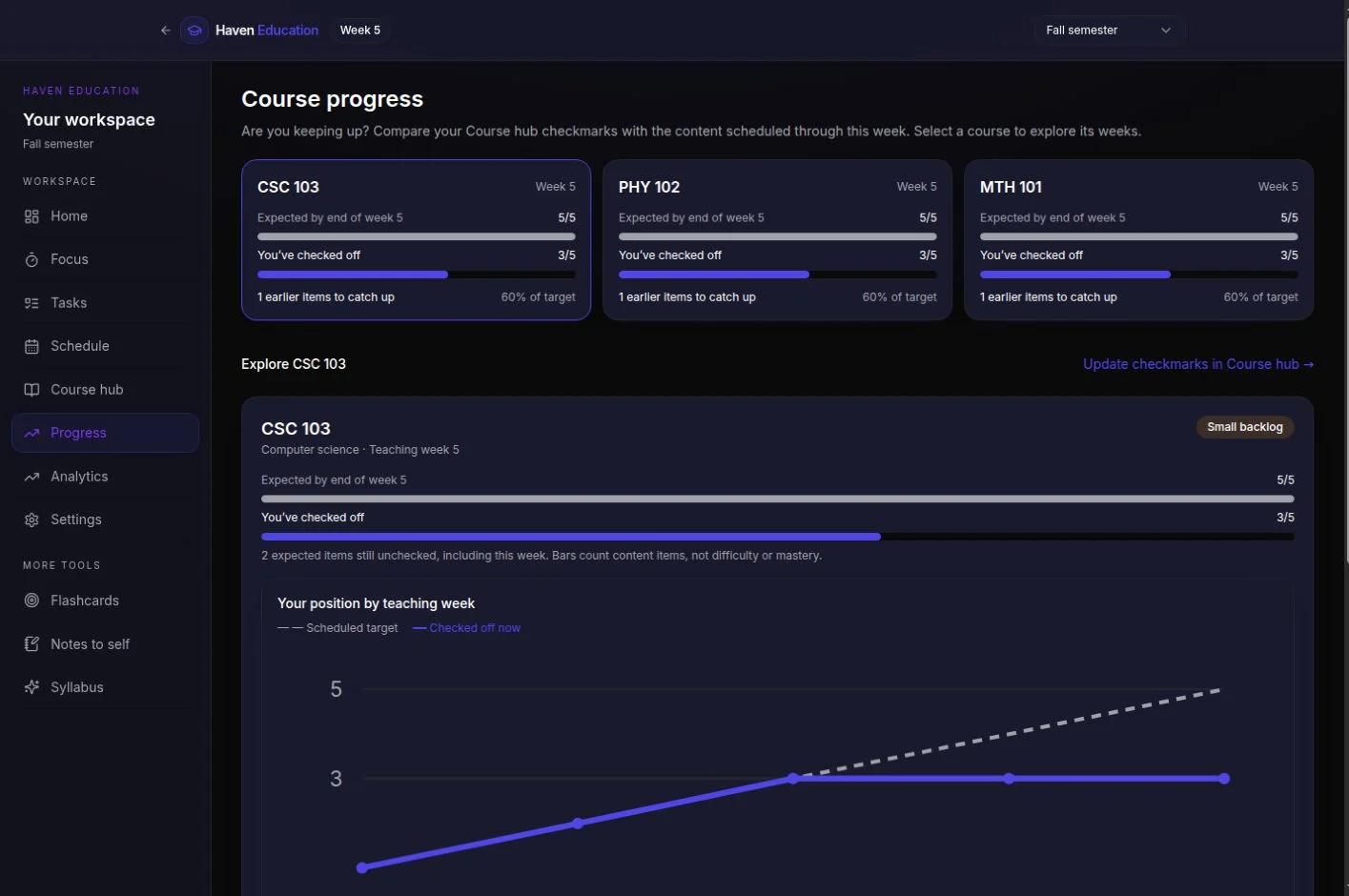
Compare scheduled teaching content with topics marked complete.
- 03 / ACTIONDaily study plan
Turn coursework and study goals into concrete, course-specific tasks.
- 04 / FEEDBACKFocus & analytics
Record study sessions against course or task context and review consistency.
Important distinction: a completed content checkbox records progress through material, not proven mastery. An AI-extracted date is a draft for the student to verify, not an authoritative deadline.
Designed for the ordinary study day.
The Today and Analytics screens are actual dark-mode captures from an isolated demo workspace. Focus and Progress show earlier development UI. All use sample coursework.
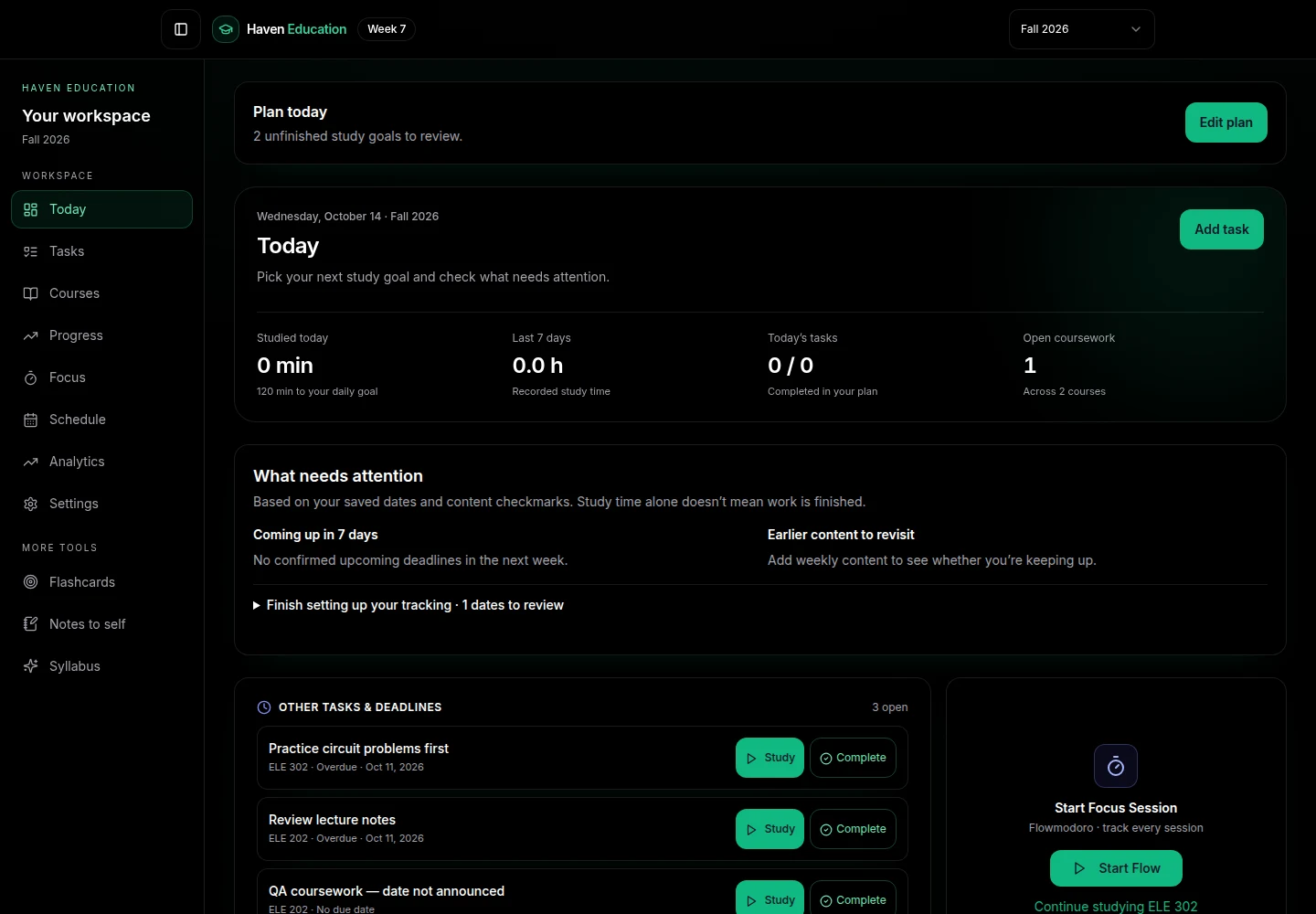
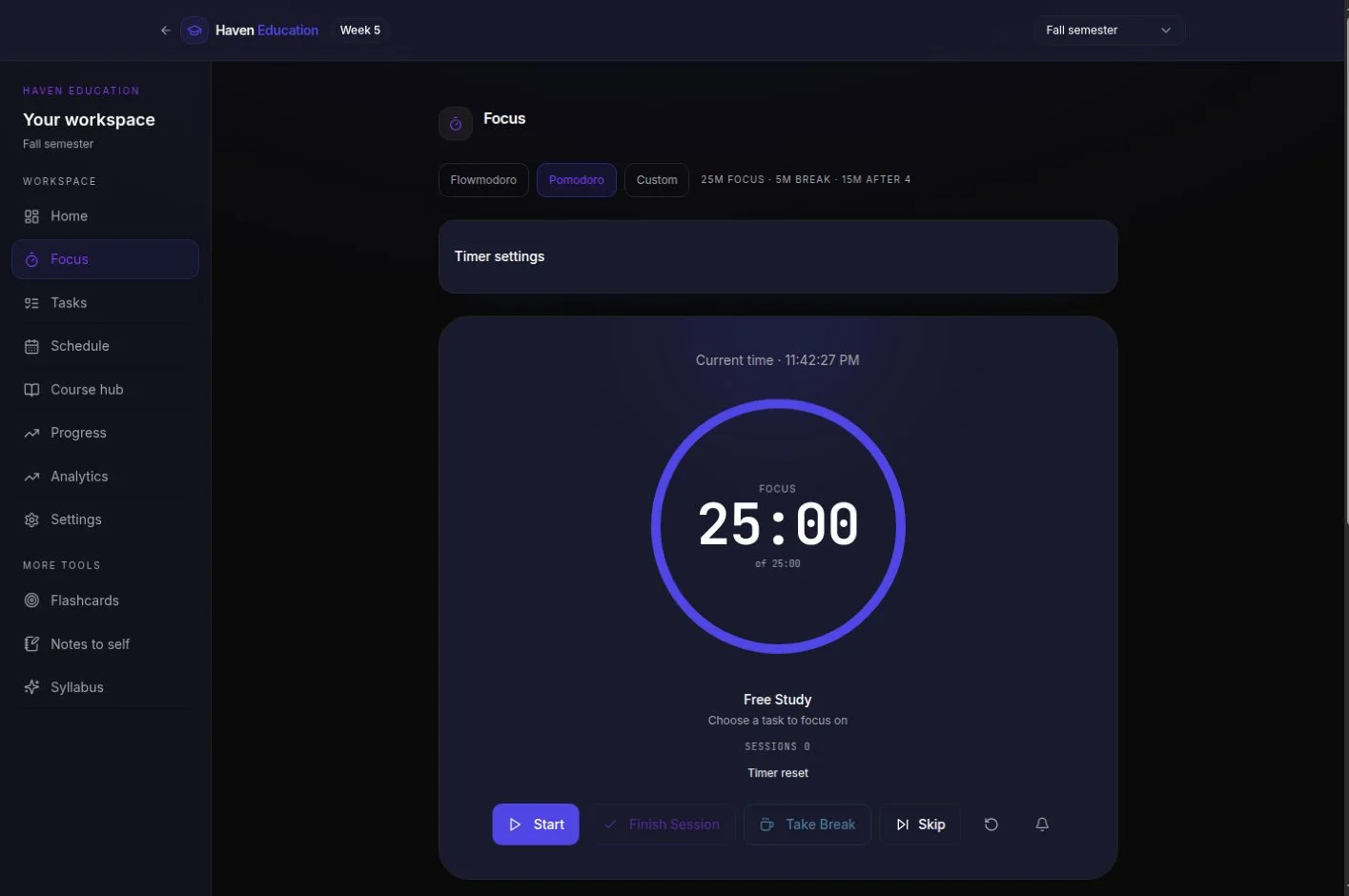
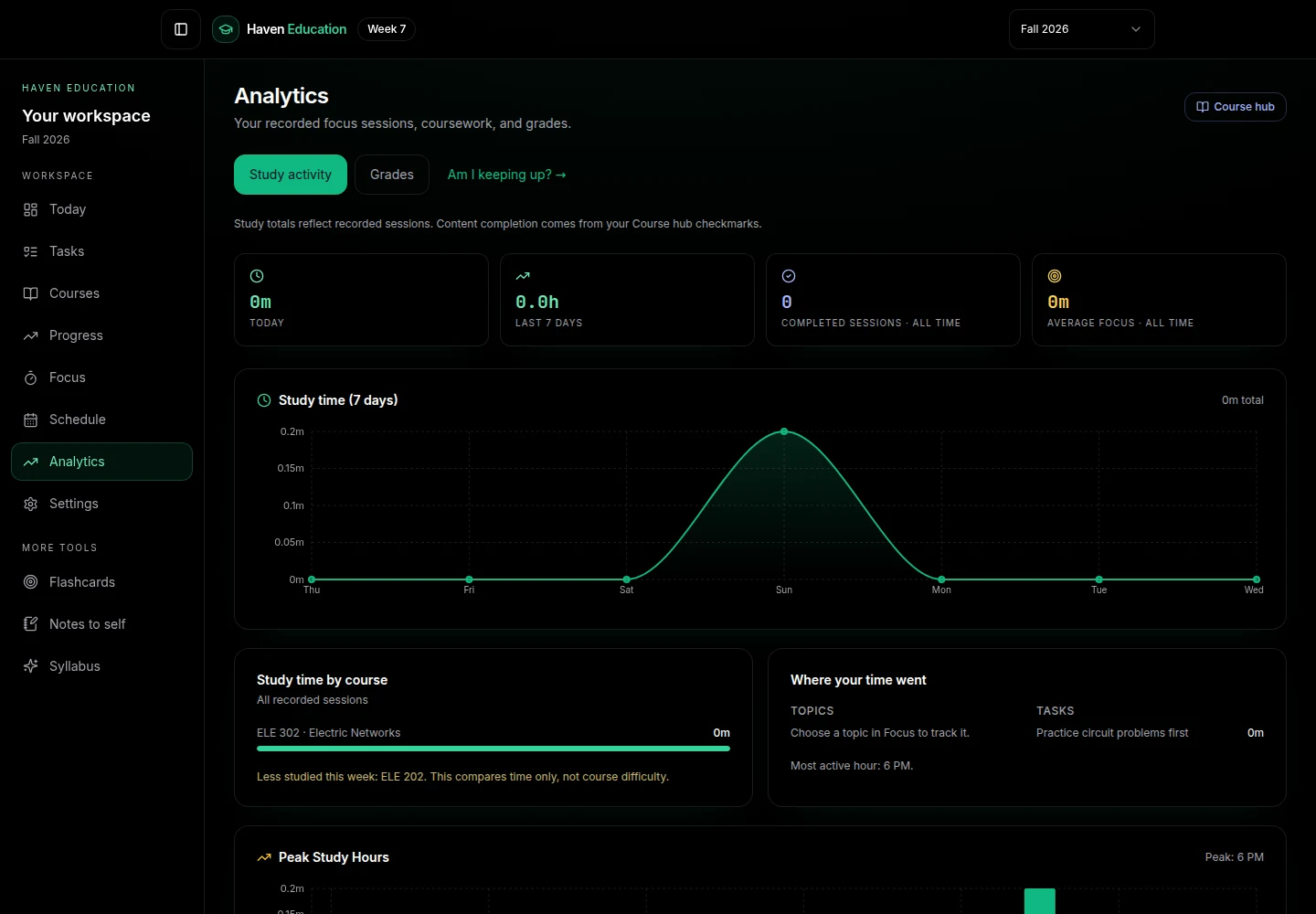
The hard part is keeping context intact.
Building a product I use changes how I approach implementation. Data from a syllabus has to become a course record; a planned task must still refer to the right course; a completed focus session should remain meaningful when I review my week.
Review before trusting AI output
The syllabus parser asks for uncertainty rather than inventing dates and runs through a review-and-save flow. Missing or ambiguous information should remain visible to the student.
Use shared context, not disconnected counters
Course, task, timetable and focus-session data feed different views. Separating the data model from page components reduces accidental disagreement between the dashboard and deeper pages.
Design around interruption
A study session may be paused, a tab may close, or a save may fail. Timer restoration and local draft recovery are part of the implementation; edge-case reliability is still being tested and refined.
Test the small behaviors
Focused application tests protect daily planning, course progress, syllabus review, and timer restoration against regressions.
Walk through one study session
Three ways the app refuses to turn uncertain inputs into false certainty.
- Syllabus review
An assessment with no confirmed time does not acquire an AI-guessed time. Conflicting source keys or repeated title/type/date identities require review, while same-title work on confirmed distinct dates can be kept. Re-importing a changed deadline does not silently overwrite previously saved work.
- Course progress
Progress compares scheduled material against explicit checkoffs. Future checkoffs are not credited toward today's expected progress, and time spent studying does not itself mark teaching content complete.
- Timer recovery
Draft restoration validates saved timing values, rejects malformed session state and clamps recovered elapsed time after a backward clock change instead of trusting a negative duration. This is narrower than proof that all device and network interruptions recover correctly.
Inspect focused test-run summary ↓Compare with actual demo UI ↑Request a private walkthrough ↗
A product is a series of decisions.
My immediate work is improving the handoff between course setup, actionable study plans and dependable session tracking—especially when information is incomplete or the interface is used on a phone.
Project status: Haven is in active development with private source. The screenshots use isolated demo data. The linked 33-test summary records focused local unit tests with mocked dependencies; it does not establish production reliability, adoption, or improved grades.
What I take from the project is just as relevant to hardware engineering: define system boundaries, make assumptions explicit, verify behavior and keep iterating when the edge cases appear.
Discuss the project